
Getting between Miami's concourses without leaving security
Find MIA's concourse connectors and D Skytrain, plus the checkpoints to use if you need security screening again.
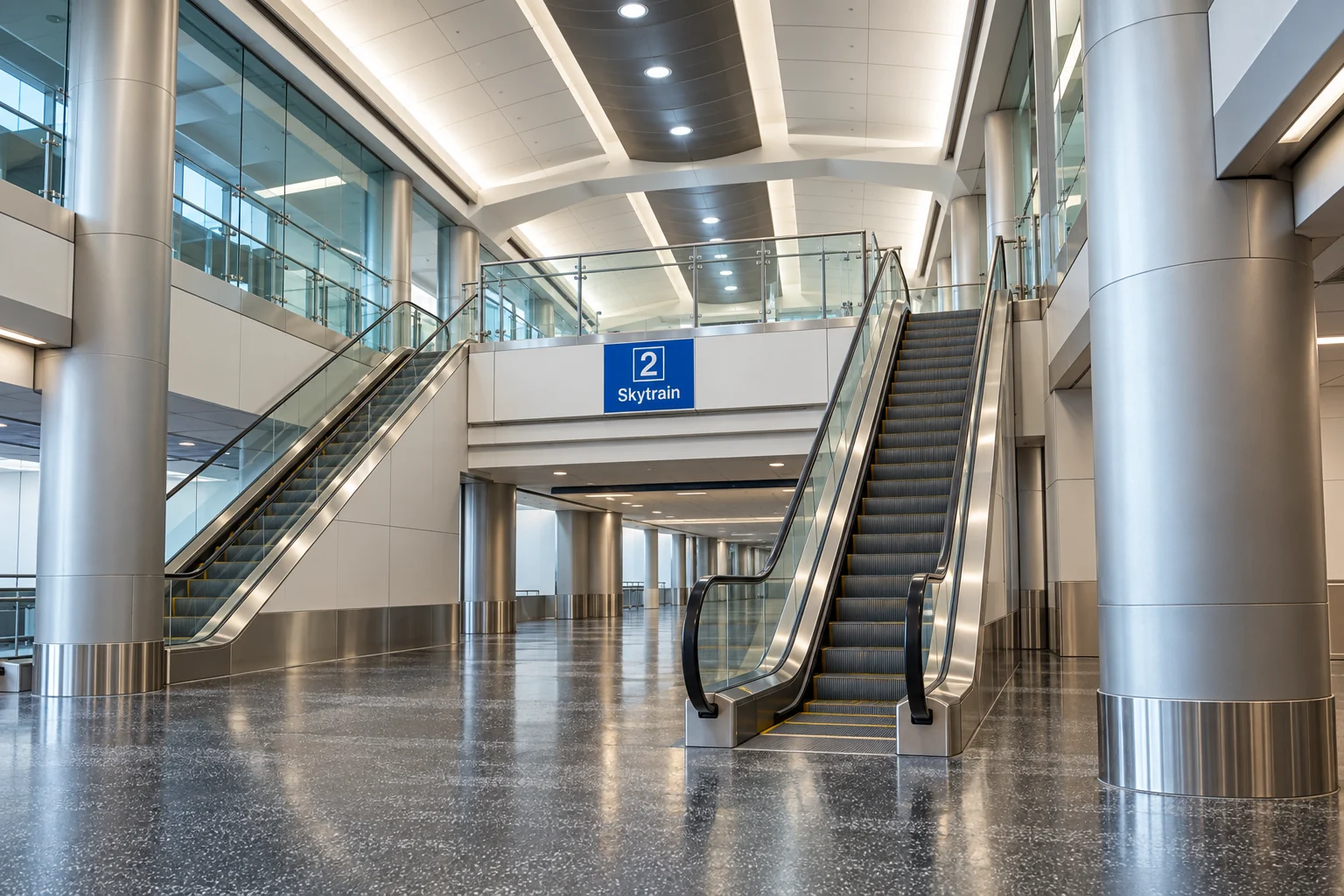
MIA maps two connectors, D–E and H–J, and lists a room after security on the H–J one. Concourse D also has a Skytrain for its own gates. MIA names no connector to F or G, so for those, get the route from your airline before leaving the gate area.
First, check both gate letters on your boarding passes or flight screens. MIA groups D in North Terminal, E, F and G in Central Terminal, and H and J in South Terminal. Our terminal map shows how those areas sit together.
| Your gates | Route to look for | Security decision |
|---|---|---|
| D and E | Look for the D–E Connector between D and E’s main concourse. | Checkpoints 4 and 5 serve both concourses if you have to rescreen. |
| H and J | Look for the H–J Connector near the bases of both concourses. | MIA lists a room there after security, and Checkpoints 8, 9 and 10 serve both concourses. |
| Two D gates | Walk or take the D Skytrain. | The train runs above D, with four stations reached by elevator. |
| E main concourse and E satellite | Follow signs for the E Train. | This train links E’s two gate areas. It doesn’t serve D or another terminal. |
| F or G and any other concourse | Your airline gives the route to your next gate. | F uses Checkpoint 6 and G uses Checkpoint 7. A route through the public terminal means screening again. |
D to E: stay with the gate signs
The D–E Connector joins Concourse D with E’s main concourse. MIA’s Plane Fun listing places the children’s area near E5 and says you can reach it from D.
Follow signs for E gates from D, or D gates from E. Watch for an exit or baggage claim sign that takes you away from the gates. One traveler filming a D-to-E transfer pointed out baggage claim signs beyond the connector. If the signs stop making sense, ask an airport or airline employee before following an exit.
Check the E gate number as well as the letter. Gates E20 to E33 sit in a separate satellite building, linked to the main E concourse by the E Train. A traveler filming a walk through E discovered that split only when they reached the train. The Central Terminal guide shows the two parts of E.
The Skytrain only crosses D
Concourse D stretches a mile, so a change between distant D gates can be a long walk. You’ll find four Skytrain stations above D. Take an elevator from the concourse to reach one. The published station guide groups D1–D19 with Station 1, D20–D25 with Station 2, D26–D39 and access toward E with Station 3, and D40–D60 with Station 4.
The Skytrain won’t take you into E, F, G, H or J. For E, ride to Station 3, the one the station guide pairs with access toward E, and walk the D–E Connector from there. MIA’s Skytrain page says trains arrive around every 3 minutes and that walking the whole length of D takes at least 30 minutes. If a station or train is down, follow the D gate signs on foot.
H and J have a connector. Ask about F and G
MIA’s South Terminal map joins H and J at the H–J Connector. MIA lists a multi-sensory room there after security. Follow the H or J gate signs to reach it from either side.
For F or G, including F to G, your airline sets the route, so get it before you head for an exit. If it sends you through the public terminal, MIA directs passengers between terminal areas along the Level 3 moving walkways. These connect to garages and the MIA Mover station. They’re not an airside concourse train.
When your airside route ends
If you arrive from another country without US preclearance, MIA says you must clear passport control before entering the United States. Precleared passengers do not clear it again. No airside connector skips that step, and MIA’s connecting-flights page says the time it takes varies. Our connecting-flights guide shows where the federal inspection exits lead.
If your airline has you collect and recheck a bag, baggage claim is on Level 1. Separate tickets alone don’t tell you whether a bag transfers, so ask the airline that sold each ticket. MIA gives no universal minimum time for these transfers. To get back in, use a checkpoint that serves your next gate:
| Checkpoint | Terminal | Gates served | Listed hours |
|---|---|---|---|
| 1 | North | D1–D60 | 4:00 a.m. to 8:15 p.m. |
| 2 | North | D1–D60 | 3:30 a.m. to 11:45 p.m. |
| 3 | North | D1–D60 | 4:00 a.m. to 9:45 p.m. |
| 4 | North | D1–D60 and E1–E33 | 4:00 a.m. to 8:15 p.m. |
| 5 | Central | D1–D60 and E1–E33 | 4:00 a.m. to 10:45 p.m. |
| 6 | Central | F1–F23 | 3:30 a.m. to 10:45 p.m. |
| 7 | Central | G1–G19 | 4:00 a.m. to 8:15 p.m. |
| 8 | South | H3–H17 and J2–J18 | 4:00 a.m. to 8:15 p.m. |
| 9 | South | H3–H17 and J2–J18 | Open 24 hours |
| 10 | South | H3–H17 and J2–J18 | 4:15 a.m. to 7:15 p.m. |
Need help while moving? Use one of MIA’s white courtesy phones or the next airline desk. For wheelchair service, contact your airline.
Sources
- MIA terminal map, Central Terminal, South Terminal, Skytrain, security checkpoints, connecting flights, Plane Fun
- Airport amenities, MIA Entering the USA